
When it comes to proving trucking company negligence after a fatal crash in Texas, the process can be complex and crucial. This guide aims to shed light on the key aspects of this challenging endeavor, offering insights that can help navigate the legal terrain with confidence and clarity.
Understanding Trucking Company Negligence
When it comes to trucking company negligence, it refers to the failure of the company to uphold their duty of care towards others on the road. This can result in unsafe practices and conditions that increase the risk of accidents.
Examples of Negligence in Trucking Companies
- Improper maintenance of vehicles, leading to mechanical failures on the road.
- Violation of hours of service regulations, causing fatigued driving by truck drivers.
- Inadequate training for drivers, resulting in lack of proper skills to handle the vehicle safely.
- Failure to properly secure cargo, leading to shifting loads and loss of control.
How Negligence Can Lead to Fatal Crashes
Negligence in trucking companies can directly contribute to fatal crashes by increasing the likelihood of accidents on the road. For example, if a truck driver is fatigued due to hours of service violations, they may fall asleep at the wheel and cause a catastrophic collision.
Similarly, if a truck's brakes fail due to improper maintenance, it can result in a deadly crash due to the inability to stop in time.
Legal Elements to Prove Trucking Company Negligence
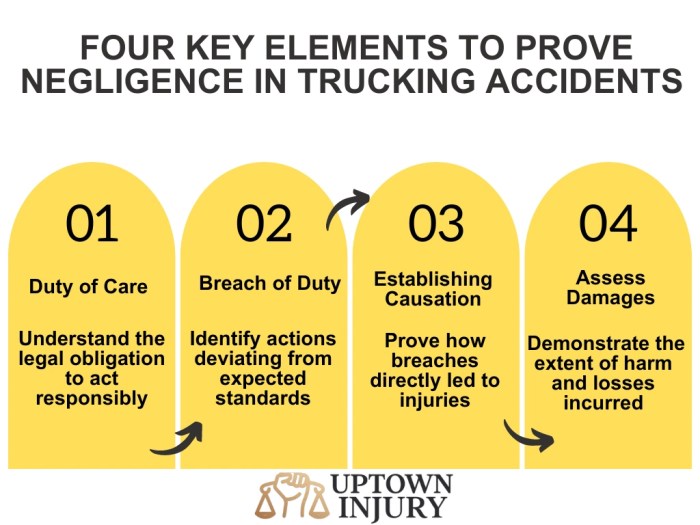
To prove negligence by a trucking company, certain key legal elements must be established. These elements serve as the foundation for holding the company accountable for their actions or lack thereof. The burden of proof lies with the plaintiff in cases of trucking company negligence, requiring them to demonstrate that the company breached its duty of care, resulting in the fatal crash.
Evidence plays a crucial role in gathering and presenting the necessary proof to establish negligence.
Establishing Duty of Care
One of the key legal elements in proving trucking company negligence is establishing the duty of care. This duty requires the trucking company to operate their vehicles in a safe and responsible manner, ensuring the safety of others on the road.
- Evidence such as company policies, training records, and maintenance logs can help demonstrate the duty of care owed by the trucking company.
- Violation of federal or state regulations, such as hours of service violations or inadequate vehicle maintenance, can also be used as evidence to establish a breach of duty.
Proving Breach of Duty
Once the duty of care is established, the next step is to prove that the trucking company breached this duty, leading to the fatal crash.
- Documentation of driver violations, such as speeding tickets or prior accidents, can indicate a pattern of negligence by the company in monitoring and disciplining their drivers.
- Accident reconstruction reports and data from electronic logging devices (ELDs) can provide valuable evidence of the company's failure to ensure safe driving practices.
Demonstrating Causation and Damages
In addition to proving duty and breach, it is essential to establish a direct link between the trucking company's negligence and the fatal crash, as well as the resulting damages.
- Medical records, expert testimony, and accident reports can help demonstrate the causal relationship between the company's actions and the tragic outcome.
- Evidence of the financial, emotional, and physical damages suffered by the victim's family can support the claim for compensation in a negligence lawsuit against the trucking company.
Investigative Procedures After a Fatal Trucking Accident
After a fatal trucking accident occurs, it is crucial to conduct a thorough investigation to determine the cause and hold the responsible parties accountable. The investigative procedures involve a series of steps to gather evidence, analyze the scene, and establish liability.
Collecting and Preserving Evidence
When authorities arrive at the accident scene, their first priority is to ensure the safety of those involved and secure the area. Evidence such as skid marks, debris, vehicle damage, and road conditions are carefully documented and photographed to reconstruct the events leading to the crash.
This evidence is crucial in determining the cause of the accident and identifying any negligence on the part of the trucking company.
- Skid marks and debris are measured and photographed to determine the speed and trajectory of the vehicles involved.
- Vehicles are inspected for mechanical issues or maintenance failures that may have contributed to the accident.
- Witness statements are recorded to gather firsthand accounts of the events leading up to the crash.
- Data from the truck's black box or electronic logging device (ELD) is analyzed to determine the driver's actions before the accident.
Role of Authorities, Experts, and Legal Representatives
During the investigation process, various parties play a critical role in gathering evidence, analyzing data, and determining liability.
Authorities, such as law enforcement officers and accident reconstruction specialists, work together to piece together the sequence of events and establish fault.
- Accident reconstruction experts use their knowledge of physics and engineering to analyze the evidence and recreate the accident scenario.
- Legal representatives on behalf of the victims or their families work to ensure that all evidence is properly collected and preserved for potential legal action against the trucking company.
- Insurance adjusters may also be involved to assess the extent of damages and determine compensation for the victims.
Documentation and Records Required for Proving Negligence
When it comes to proving trucking company negligence after a fatal crash in Texas, having the right documentation and records is crucial. These documents serve as evidence to support your case and hold the responsible party accountable.
Essential Documents and Records
- Driver's logs: These logs provide valuable information on the driver's hours of service, rest breaks, and adherence to regulations.
- Maintenance records: These records detail the truck's maintenance history, including inspections, repairs, and any issues found.
- Training records: Training documents show whether the driver received proper training on safety protocols and regulations.
- Accident reports: Obtaining accident reports can help reconstruct the events leading up to the crash and identify any contributing factors.
Accessing and Analyzing Trucking Company Records
Accessing trucking company records can be a challenging task, but it is essential for gathering evidence of negligence. You can request these records through legal channels such as subpoenas or requests for production of documents. Once obtained, analyze the records thoroughly to identify any discrepancies or violations that point to negligence.
Importance of Preserving Communication Records and Logbooks
Communication records, including emails, text messages, and phone logs, can provide valuable insights into the interactions between the trucking company, drivers, and other parties involved. Additionally, preserving logbooks is crucial as they document the driver's activities and compliance with regulations, serving as crucial evidence in proving negligence.
Expert Witnesses and Their Role in Proving Negligence
Expert witnesses play a crucial role in cases involving trucking company negligence by providing professional opinions and analyses to support claims of negligence. These individuals are typically specialists in a particular field related to the case, such as accident reconstruction, trucking regulations, or mechanical engineering.
Significance of Expert Witnesses
Expert witnesses bring a level of credibility and authority to the legal proceedings. Their specialized knowledge and experience allow them to offer valuable insights that can help establish negligence on the part of the trucking company. By presenting expert testimony, lawyers can strengthen their case and provide the court with a more comprehensive understanding of the issues at hand.
Selection and Preparation of Expert Witnesses
The process of selecting an expert witness involves identifying individuals with the necessary qualifications and expertise relevant to the case. Attorneys must ensure that their chosen expert is credible, unbiased, and capable of effectively communicating complex information to the judge and jury.
Once selected, expert witnesses must be thoroughly prepared for their testimony, including familiarizing themselves with the details of the case and practicing their presentation.
Presenting Expert Witnesses in Court
During legal proceedings, expert witnesses are called upon to provide their professional opinions and analyses to support the claims of negligence. They may use various tools and methodologies to demonstrate how the trucking company's actions or inactions contributed to the fatal accident.
Expert witnesses play a key role in helping the court understand technical aspects of the case and make informed decisions based on the evidence presented.
Final Review
In conclusion, understanding how to establish trucking company negligence after a fatal crash in Texas is paramount for seeking justice and accountability. By following the Artikeld legal elements, investigative procedures, and documentation requirements, individuals can strengthen their case and pursue rightful compensation.
Helpful Answers
What are the common examples of negligence in trucking companies?
Negligence in trucking companies can include violations of safety regulations, improper maintenance of vehicles, driver fatigue, and inadequate training.
How can evidence be gathered and presented to establish trucking company negligence?
Evidence can be collected through accident reports, witness statements, electronic logging devices, and data from the truck's black box. This evidence is then presented in court to demonstrate negligence.
Why is it important to preserve communication records and logbooks in proving trucking company negligence?
Preserving communication records and logbooks is crucial as they can provide insights into the actions and decisions made by the trucking company, highlighting any negligence that may have contributed to the fatal crash.